

Setting the Record Straight About Immigrants

As Americans, I think we can all agree that immigrants in our country should follow US laws. We also agree that those who commit serious crimes should not be allowed to remain at large. Imprisonment or deportation of these individuals to their home countries is supported by almost all Americans as well.
Those who voted for the current administration supported the purported policy of deporting the “worst of the worst” immigrants who are here illegally. For many, this was the primary reason for their vote. For others, promises of favorable economic policy were more convincing, but they (mistakenly) linked the presence of immigrants to an unfavorable economy or lack of job opportunities.
Unfortunately, many of the perceptions about the effects of immigrants—whether they entered the country legally or not—are inaccurate. This is due to a great deal of misinformation and targeted, malicious disinformation. Remember “they’re eating the dogs and the cats”? It was a deliberate smear against hard-working, legal Haitian residents of Springfield, Ohio. Today, it’s Somalis in Minnesota, whom Trump has labeled “garbage”. Please be skeptical when all immigrants from a specific country are painted with the same broad brush.
Let’s be clear: this kind of broad characterization of immigrant populations or people of color, many of whom are US citizens, is racist. No human being deserves to be called garbage.
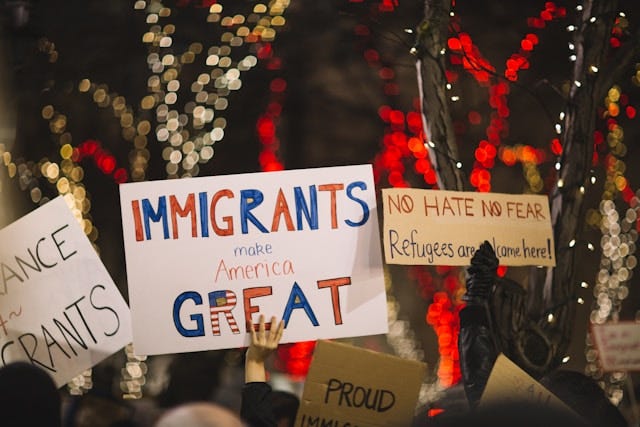
Common Misinformation — and What’s Actually True
Relying on word-of-mouth reports and fictional racist narratives intended to instill outrage and garner political advantage is simply not responsible. It’s actually quite dangerous. Instead, let’s examine half a dozen of the more popular misperceptions that circulate widely with little or no basis in truth.
1. Misperception: Immigrants take jobs away from U.S.-born citizens.
Truth: Many immigrants fill jobs that native-born Americans do not want or are not available for — for example, in agriculture, construction, service industries, and other high-demand fields. Many immigrants also create jobs by starting businesses. (American Immigration Council)
2. Misperception: Immigrants don’t pay taxes.
Truth: Immigrants — including undocumented ones — pay income taxes, payroll taxes, sales taxes, and property or rent taxes. Their tax contributions help fund government services even if they don’t all qualify for benefits. (American Immigration Council)
3. Misperception: Immigrants are a drain on public benefits / welfare.
Truth: Many immigrants — especially recent arrivals or undocumented migrants — are ineligible for many public benefit programs. And overall, immigrants contribute more in taxes and economic output than they receive in benefits. (National Immigration Law Center)
4. Misperception: Immigrants increase crime and make communities unsafe.
Truth: A robust body of research finds that immigrants (documented and undocumented) are less likely to commit crimes than U.S.-born residents. Areas with high immigrant populations often have lower crime rates. (Migration Policy) According to the CATO Institute, only 5% of ICE detainees have criminal convictions and 73% have no convictions. The percentage of detainees with no convictions has been growing steadily all year. The worst of the worst?
5. Misperception: There are more immigrants today than ever before in U.S. history.
Truth: Actually, we are all immigrants. However, the share of new immigrants in the U.S. population today (~14%) is similar to what it was during the major immigration waves of the late 19th/early 20th centuries. (Princeton Economics)
6. Misperception: Immigrants refuse to integrate, don’t want to assimilate or learn English.
Truth: Many immigrants make efforts to integrate — learn English, participate in civic life, start businesses, raise families, and contribute socially and economically. There is no evidence of a general unwillingness to assimilate. As a former ESL assistant teacher in Texas, I can personally attest to this one. Students in our classes were enthusiastic about learning English! (Jinhee Wilde Foundation)
Why These Misinformation Narratives Persist
Political rhetoric and media framing sometimes amplify fear — using examples of individual cases to generalize about entire immigrant populations. The prime example of this was the claim that Haitian refugees were eating their neighbor’s pets. First, it was never true of even one Haitian but generalizing it to all Haitians was cruel and disruptive—they were maligned to score political points only. The same may be said of the current uproar over Somali immigrants and alleged fraud. Some Somalis may have committed fraud, but it’s not fair to assume all Somalis commit fraud, any more than it would be to assume all University of Washington graduates are serial killers, because Ted Bundy attended the school.
These misconceptions often rely on simplistic or anecdotal reasoning rather than data. Scholars call this the Dillingham Flaw — when people use oversimplified categories or outdated comparisons to draw misleading conclusions about immigrants. The term was coined by sociologist Vincent N. Parrillo to describe flawed logic of nativists who wrongly assume newer immigrants are less capable of assimilating than “older” ones. Their assumptions are based on biased comparisons and focus on differences rather than similarities, creating a false sense of crisis that ignores historical context and the eventual integration of past groups. It stems from the early 20th-century Dillingham Commission’s biased reports, which, despite evidence, concluded “new” immigrants were undesirable, leading to restrictive policies like literacy tests and quotas. Sound familiar?
Finally, immigration is a complex phenomenon — involving labor markets, demographics, global movement, legal systems — which makes generalizations easy but often wrong. Finding the truth involves some work: consulting and analyzing multiple credible sources. As a researcher, I can tell you it’s time consuming and often frustrating. One of my grad school professors told our Journalism Research class: “Continue researching until you find the same ideas or evidence repeated in several credible sources. Then you can have confidence that you’ve found the best possible information.” The implication was that finding a couple of sources whose facts happen to coincide is just not adequate. Keep searching. And, of course, the trustworthiness of the sources matter also.
What Research and Data Show: A More Accurate Picture
Immigrants help sustain the U.S. workforce and boost the economy, especially as the native-born workforce ages and birth rates decline.
Immigrants contribute significantly in taxes, even if undocumented, often without ever being eligible for benefits.
Immigrants are overwhelmingly law-abiding; higher immigrant populations often correlate with lower crime rates.
Immigrants often become entrepreneurs or skilled workers — creating jobs, innovation, and economic growth, benefiting both immigrant and native-born populations.
One Immigrant Story
I have a personal experience that shapes my own perception about immigrants. Three years ago, a group of individuals from several area Presbyterian churches, including my own, chose to sponsor a Muslim Afghan family for resettlement in Texas. The family was migrating here shortly after the disastrous collapse of the Western Alliance in Afghanistan and just before the Taliban takeover. The family consists of a father, mother, and their six children. The father had worked for years with US forces as an interpreter and teacher of English to his countrymen, activities which posed a danger for him when the fledgling government failed.
Over the course of two years, dozens of people from the resettlement group offered financial contributions, material resources like a rent-free home, an older but drivable car, and assimilation support. My husband had a key role in the group, helping the family apply for the food benefits their visa classification legally entitled them to and helping the two eldest sons learn to drive. I sometimes provided transportation for the older children to or from school or jobs. I learned a great deal from them about persistence in the face of unbelievable hardship.
In return for our support, we were overwhelmed with Afghan hospitality. They are joyous and generous hosts! Every visit to their home was accompanied by fresh tea, nuts, dried fruits, and other snacks. The family is deeply appreciative of our support, while still grieving the loss of security in their homeland and separation from extended family. Today, the three oldest children in the family are attending college nearby and the father is securely employed as an IT contractor for a large technology company, with a side hustle providing computer technology services for several business clients.
This family faithfully pursued every step in the legal path to resident status. They just received their green cards—three days before the November shooting of two National Guard members in Washington, D.C., by an Afghan refugee. Even though the shooter had been vetted by the Trump administration earlier this year, the previous administration was falsely blamed for sloppy screening, and a ban is now imposed on accepting or processing Afghan nationals for residency. I’m delighted our new friends are now legal US residents but saddened for Afghans who cooperated with American forces and were promised safe refuge in the US, but who may never find it. They are now universally condemned by the actions of one ignorant man.
The Bottom Line About Immigrants to the US
The US is often called a country of immigrants, because as recently as three or four generations ago, the population consisted primarily of citizens who immigrated from other countries. However, most of us alive today are considered “immigrant derived.” My own paternal great-grandparents immigrated from Germany and Poland at the end of the 19th century. My grandparents and parents were born in the US, as I was. However, I am proud of my heritage, as most Americans are of theirs.
It’s foolish to presume that Americans are monolithic. We are diverse. We are who we are because of what we inherited from our immigrant ancestors, wherever they migrated from. We share elements of our cultures with our neighbors, enriching us all. American culture is a “melting pot” of many cultures, despite many who insist there is one American culture to preserve.
When you hear fear-mongering speech that warns against the dangers of an entire immigrant population, please be responsible enough to search out the facts. When you hear friends or colleagues complain about “filthy” immigrants “soaking the system” or “stealing American jobs,” please provide them with relevant facts that disrupt the misinformation they’ve bought into.
What a fabulous review of Misperception that exists around our immigrant community. Thank you.